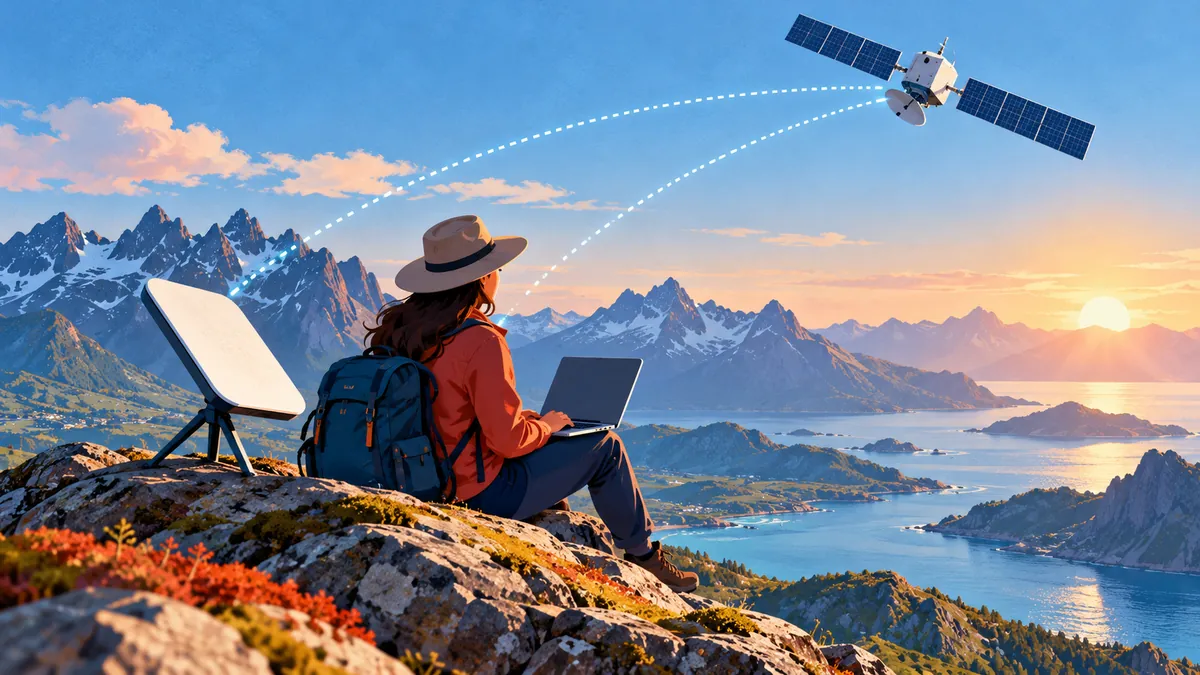
Beyond Cell Towers
For decades, traveling to remote destinations meant going offline. Satellite internet is changing that, bringing connectivity to places cell towers can't reach.
How Satellite Internet Works for Travelers
Modern satellite internet (LEO — Low Earth Orbit) provides internet through a constellation of thousands of small satellites orbiting close to Earth. This means:
- Lower latency than traditional satellite (20–40ms vs 600ms+)
- Faster speeds (50–200 Mbps download)
- Growing global coverage including oceans, deserts, and mountains
Where Satellite Internet Matters Most
Remote Hiking & Camping
Satellite messengers and emergency SOS devices now work almost everywhere on Earth. Some smartphones (iPhone 16, Pixel 9) include satellite connectivity for emergencies.
Cruise Ships
Starlink Maritime has transformed cruise ship internet from painfully slow to genuinely usable. Many cruise lines now offer Starlink-powered WiFi.
Safari & Wildlife Travel
Remote lodges in Africa and South America increasingly offer satellite internet, keeping guests connected without cell infrastructure.
Mountain Travel
Base camps, mountain lodges, and ski resorts in remote areas are adopting satellite internet for reliable coverage.
Satellite vs eSIM: Which Do You Need?
- You're in or near cities and towns
- Standard cell coverage exists
- You want affordable, high-speed data
- You're truly off-grid (no cell towers)
- Emergency communication is critical
- You're on a ship or in extremely remote areas
Best approach: Use an eSIM as your primary connection and satellite as your emergency backup.
The Future
By 2028, direct-to-phone satellite connectivity will likely be standard on most smartphones, eliminating dead zones entirely. Until then, carry both an eSIM and a satellite device for true global coverage.
Key Takeaway
Satellite internet is a complement to eSIMs, not a replacement. For 95% of travel, an eSIM provides better speed, lower cost, and easier setup. Satellite fills the remaining 5% where cell towers don't exist.