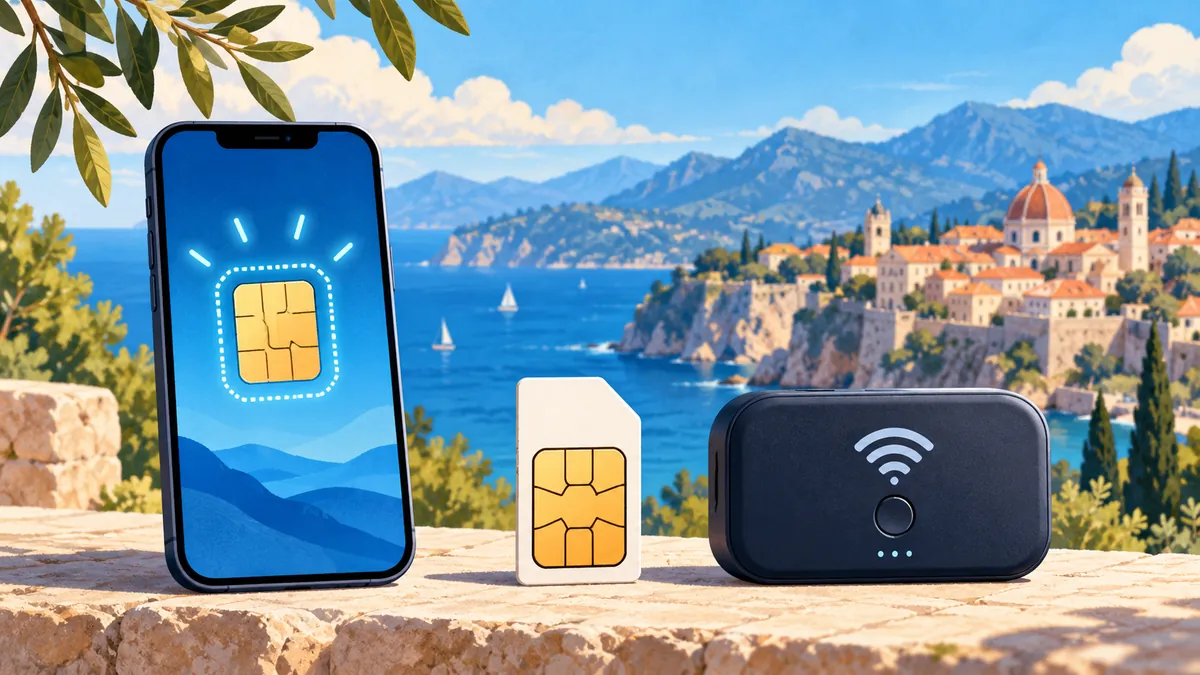
Three common ways to get online abroad: a travel eSIM, a local SIM card, or a pocket WiFi device. Here's how they compare on cost, convenience and coverage so you can pick the right one.
Quick comparison
- eSIM: Download and activate in ~2 minutes, before you even fly. No store, no extra device. Best for most travelers.
- Local SIM: Often cheap once you have it, but you must find a shop, show ID, and swap your physical SIM (losing your home number temporarily).
- Pocket WiFi: Shares one connection across devices, but it's an extra gadget to rent, carry and charge — and you both have to stay together.
Cost
eSIMs are highly competitive — Wanderly plans start at $1.99 with data as low as $0.48/GB. Local SIMs can be cheap but cost you time and sometimes a tourist markup. Pocket WiFi rentals add daily device fees and deposits that add up on longer trips.
Convenience
eSIMs win: buy online, install at home, connect on landing. Local SIMs mean airport queues; pocket WiFi means pickups, returns and a device to babysit and recharge.
Coverage
A quality eSIM marketplace like Wanderly aggregates multiple carriers, so you're matched to strong local networks in 200+ countries. Local SIMs use one carrier; pocket WiFi depends on the device's single network.
Battery & practicality
Pocket WiFi drains a separate battery and yours if tethered. An eSIM uses your phone directly with no extra hardware. You can also keep your home number active alongside an eSIM — see our dual-SIM guide.
Which should you choose?
For most travelers, an eSIM is the simplest, most cost-effective option. Consider a local SIM only for very long single-country stays, and pocket WiFi only if you need to connect many devices with no eSIM support. New to eSIMs? Start with what is an eSIM and how it works.
Get started
Browse eSIM plans for your destination on Wanderly, or compare sizes on our pricing page.