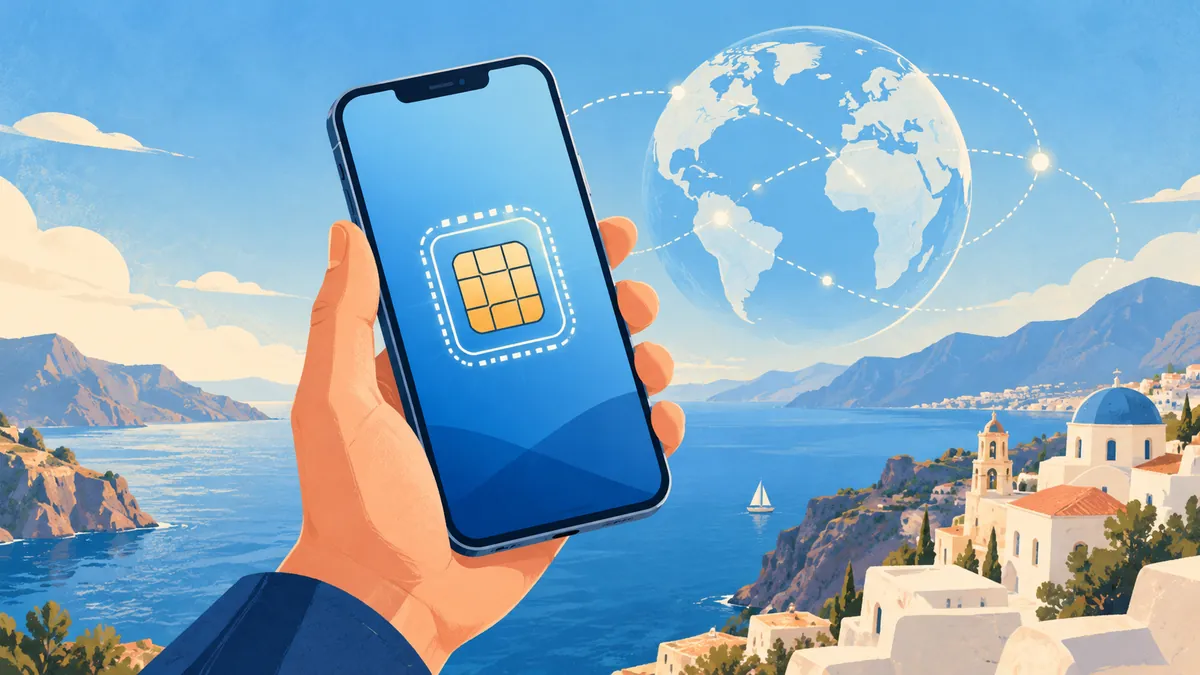
An eSIM (embedded SIM) is a digital SIM card built into your phone — no plastic card required. Instead of swapping a physical SIM, you download a mobile plan and activate it with a QR code. For travelers, that means getting online abroad in minutes without hunting for a local SIM shop.
How does an eSIM work?
Your phone has a small reprogrammable chip that stores mobile plans digitally. When you buy an eSIM plan, you receive a QR code; scanning it installs the plan onto that chip. You can store multiple plans and switch between them in Settings — handy for keeping your home number while using local data abroad.
Benefits of an eSIM for travel
- Instant setup: activate in ~2 minutes — no store, no queue.
- No roaming fees: pay local-style rates instead of $10–15/day carrier roaming.
- Keep your number: run your home SIM for calls/texts and the eSIM for data (dual-SIM guide).
- Activate before you fly: install at home and connect the moment you land.
Does my phone support eSIM?
Most iPhones (XS and newer), Google Pixel 3+, and recent Samsung Galaxy phones support eSIM. See our full eSIM compatible phones list to be sure.
How to set up an eSIM
1) Choose a plan for your destination. 2) Receive a QR code by email in seconds. 3) Scan it to install. 4) Enable data roaming for the eSIM line when you arrive. Step-by-step: iPhone · Android.
eSIM vs physical SIM
A physical SIM means finding a shop, showing ID, and swapping the tiny card. An eSIM skips all of that — it's downloaded and activated digitally, and you can hold several plans at once. Curious how it compares to pocket WiFi too? Read eSIM vs local SIM vs pocket WiFi.
FAQ
Is an eSIM safe? Yes — it's the same carrier technology as a physical SIM, just digital. See our eSIM security guide.
Where do I buy one? Browse plans for 200+ countries on Wanderly destinations, from $1.99.
## eSIM vs Physical SIM at a Glance | Feature | eSIM | Physical SIM | |---------|------|--------------| | Activation | Instant (minutes) | Wait for shipping | | Storage | Multiple profiles on one phone | One card at a time | | Damage risk | None (it is digital) | Can be lost or damaged | | Switching plans | Tap to switch | Physically swap cards | ## Is My Phone eSIM Compatible? Most phones from 2019 onwards support eSIM: - **Apple**: iPhone XS and newer - **Samsung**: Galaxy S20 and newer, plus the Galaxy Z Fold/Flip series - **Google**: Pixel 3 and newer Check our [compatibility guide](/compatibility) for the full list, then [browse destinations](/destinations) to get connected.